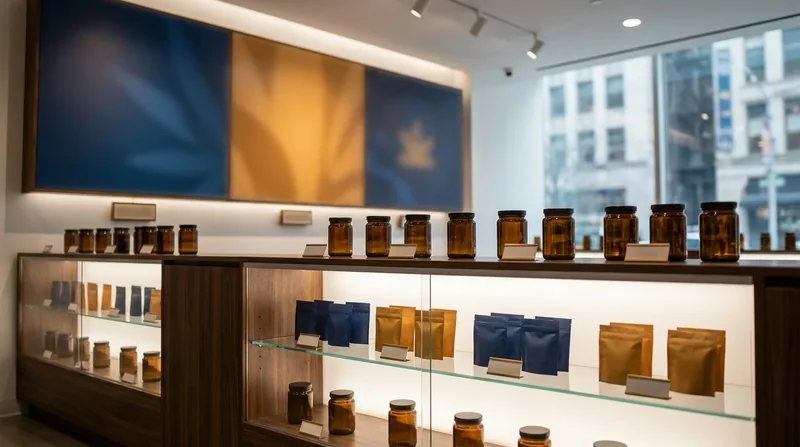
How to Open a CBD, Hemp or Kratom Shop in Pennsylvania
How to Open a CBD, Hemp or Kratom Shop in Pennsylvania
Opening a CBD, hemp or kratom shop in Pennsylvania is mostly a standard small business setup with three product-specific questions on top: what you can legally sell, how you describe it, and where your inventory comes from. Pennsylvania does not issue a state retail license for hemp or CBD, so a search for a “pa hemp license” or “pennsylvania hemp permit” usually leads to the wrong program. The Pennsylvania Department of Agriculture (PDA) hemp permit is for growers and processors, not for stores that sell finished products. Kratom and intoxicating hemp products, including delta-8 THC, are the areas where the rules are least settled, so verify them before you order any stock.
Informational content only. This article is not legal or tax advice. Hemp, cannabinoid and kratom rules change quickly, and federal and state rules can conflict. Talk to a Pennsylvania business attorney and a CPA before you sign a lease or place a large inventory order. Confirm every figure and date below on the agency page before you act.
What You Need Before You Start
Gather these items before you file anything. Most are required, and a few save you from re-filing later.
- A business name checked against the Department of State business search at file.dos.pa.gov/search/business.
- A legal entity: a sole proprietorship, a general partnership, an LLC or a corporation. An LLC is the common choice for a single shop, but the decision depends on your liability exposure, your partners and your tax picture.
- A Pennsylvania street address for your registered office. A post office box alone is not accepted.
- A federal Employer Identification Number (EIN) from the IRS.
- A Pennsylvania sales tax license, registered through myPATH.
- A signed lease, or written confirmation from the property owner, plus a zoning check. Zoning is local, and the municipality can restrict where a shop that sells these products may operate.
- A third-party certificate of analysis (COA) from a testing lab for every hemp or CBD product you plan to carry.
- Business insurance quotes, including general liability and product liability coverage. Get these before you commit to a lease.
- A point-of-sale system that can record age checks, lot numbers and product batch information.
Step 1: Choose Your Entity and File It
Formation runs through the Pennsylvania Department of State, Bureau of Corporations and Charitable Organizations, using Business Filing Services at file.dos.pa.gov. For an LLC, you file the Certificate of Organization, Domestic Limited Liability Company (Form DSCB:15-8821) with a Docketing Statement (DSCB:15-134A). The filing fee is $125. The Bureau asks filers to allow about 15 business days for processing.
Expedited service is available for an added fee, online or in person only, not by mail. It is charged in addition to the $125 filing fee: $100 for same day service if received before 10:00 a.m., $300 for 3 hour service if received before 2:00 p.m., and $1,000 for 1 hour service if received before 4:00 p.m. A separate $70 Special Processing fee can be added if you need several same day documents filed in a specific order.
The name must include “company,” “limited,” or “limited liability company,” or an abbreviation of one of those terms. It may not contain words that imply a business corporation, such as “corporation” or “incorporated.” The name must also be distinguishable from names already on file. If you need time to finish the paperwork, you can reserve a name for 120 days for $70.
A corporation files Articles of Incorporation, For Profit, with the same $125 fee and Docketing Statement. A corporation must also advertise notice of the filing in two newspapers of general circulation, one preferably a legal journal, and keep proof of the publication in the corporate minutes. Ask your attorney whether that extra step is worth it for your structure. An LLC has no publication requirement.
On taxes, Pennsylvania has no LLC franchise tax and no separate LLC annual tax. A standard LLC is treated the same as its federal classification. Profit passed through to the owners is taxed at the flat 3.07 percent Personal Income Tax rate. An LLC taxed as a corporation pays the Corporate Net Income Tax, which is 7.49 percent for tax years beginning in 2026.
Step 2: Set Up a Registered Office
Pennsylvania does not use registered agents. Every filing entity must instead list a registered office in Pennsylvania with a street and number. If the business has a physical or mailing address in Pennsylvania, use that address. If it does not, you may contract with a Commercial Registered Office Provider (CROP) under 15 Pa.C.S. section 109 and list the CROP name and county of venue in place of an address.
Do not list a CROP without an actual contract. Doing so can carry civil and criminal penalties. A CROP also cannot be used where a principal place of business is required, which includes fictitious name registrations. A retail shop will almost always have a real street address, so most shops do not need a CROP at all.
Step 3: Register a Fictitious Name If You Trade Under a Different Name
If your storefront name differs from the name you filed for your entity, register it. The Registration of Fictitious Name (Form DSCB:54-311) costs $70. It is filed statewide with the Department of State, not with your county. Details are at pa.gov/agencies/dos/programs/business/types-of-filings-and-registrations/fictitious-names.
Step 4: Register for Taxes and Your Sales Tax License
Pennsylvania has no state general business license and no county business licenses. The Bureau of Corporations and Charitable Organizations does not issue activity licenses. What you do need is a sales tax license, which you register for through myPATH at pa.gov/services/revenue/register-my-business-for-taxes. The old PA-100 form was retired in 2022, so do not look for it. The state sales tax rate is 6 percent. Confirm with the Pennsylvania Department of Revenue how each of your product categories is taxed. The Sales, Use and Hotel Occupancy Tax License is free.
Ask your municipality about any local requirements for retail operations. A missing county license does not mean there are no local rules.
Step 5: Understand the Hemp and CBD Rules
There is no state retail license for hemp or CBD products. Your core question is whether you need a PDA hemp permit. For most shops that only resell finished products, the answer is no. PDA hemp permits are for growers and processors. If you extract, manufacture or repackage hemp material yourself, ask PDA whether a processor permit applies to your activity.
For context, PDA issued 170 growing permits and 32 processing permits in 2026. Applications for 2027 have been open since October 1, 2026. If you plan to grow or process, read PDA’s current permit guidelines for siting rules before you sign a lease for production space. Those rules can decide whether a location works at all.
On CBD, the FDA’s stated position is that CBD cannot be added to food or sold as a dietary supplement under current law. The agency has approved one CBD-derived prescription drug and has not approved CBD for general use. Pennsylvania has no separate state retail license that resolves this, so your product descriptions and marketing need to stay factual and avoid health claims.
On delta-8 and other intoxicating hemp products, Pennsylvania has not enacted a law that specifically addresses them. That silence is not permission. The federal picture is also shifting: the narrower federal hemp definition takes effect November 12, 2026, unless Congress delays it. Products that fall outside the narrower definition may stop qualifying as legal hemp products under federal law. If you are researching pa thc laws or pennsylvania delta 8 rules, the honest answer is that the question is unsettled. Get written advice from a Pennsylvania attorney on federal and state exposure before you stock any intoxicating product, and plan for the possibility that inventory may have to come off the shelf.
Step 6: Check Kratom Rules Before You Stock
Pennsylvania’s kratom rules are unsettled. Before you sell kratom, contact the Pennsylvania Department of Health and ask in writing what applies to retail sales, product standards, labeling and age restrictions. Get the answer in writing and keep it in your records. Do not rely on what other shops in your area do, or on the rules in a neighboring state, to decide what you can sell here.
Kratom is also a product where federal health agencies have raised safety concerns. FDA has not approved kratom for any medical use. Plan your product descriptions, staff training and age policy with that in mind, even if the state rules turn out to be permissive.
Step 7: Source Products and Set Compliance Practices
Vet each supplier before you place an order. Ask for a third-party COA for every batch, not just a sample, and check that the lot number on the COA matches the lot number on the package. Keep the COAs on file and link them to your point-of-sale records. If a supplier cannot produce a current COA, do not stock the product.
Review every label before it reaches the shelf. Keep the wording factual: ingredients, milligram content as tested, batch number and the supplier’s contact information. Avoid words such as “treats,” “cures” or “relieves anxiety.” Those claims invite FDA and Federal Trade Commission scrutiny, and they are the most common reason small shops get into trouble. Train staff to say the same thing, because a clerk’s verbal pitch can create the same problem as a label.
Common Mistakes to Avoid
- Buying a PDA permit you do not need. A retail shop that only sells finished goods does not apply as a grower or processor.
- Treating delta-8 as settled. Pennsylvania has no enacted law on intoxicating hemp, and federal definitions change on November 12, 2026, unless Congress delays it.
- Stocking kratom before asking. Get the Department of Health answer in writing first.
- Using a post office box as the registered office. A Pennsylvania street address is required.
- Listing a CROP without a contract. That can carry civil and criminal penalties.
- Trading under a shop name without a fictitious name registration. File the $70 registration.
- Making health claims on signs, labels or social media. Keep descriptions factual.
- Missing the annual report. LLC annual reports are due January 1 to September 30 each year, and corporation reports are due January 1 to June 30.
- Assuming no county license means no local rules. Confirm zoning with the municipality before you sign.
What to Expect and When
A realistic plan runs in stages. Entity filing with standard processing takes about 15 business days, so start the name check and entity filing first, then set up the registered office, sales tax registration and zoning confirmation while you wait. Expedited service can shorten the formation step, but it does not shorten the time you need for supplier vetting, lease negotiation or insurance. Plan for those to take longer than the state filing.
You should expect a compliant shop to be slower to open than the filing timeline suggests. Many owners find that the product sourcing and label review take the most time. Results are likely to be better if the shop is set up as a factual retailer from day one, because it avoids the claims problems that can force a rebrand or a recall later. Customers may ask what a product is for, and staff can answer with the product facts from the COA and label without making medical claims.
| Task | Agency or site | Cost | Timing |
|---|---|---|---|
| LLC Certificate of Organization | Department of State (file.dos.pa.gov) | $125 plus optional expedite fees | About 15 business days standard |
| Name reservation | Department of State | $70 | Reserved for 120 days |
| Fictitious name registration | Department of State | $70 | Before you trade under that name |
| Sales tax license | Department of Revenue via myPATH | Free | Before you make taxable sales |
| LLC annual report | Department of State | $7 | January 1 to September 30 each year |
| Corporation annual report | Department of State | $7 | January 1 to June 30 each year |
| PDA hemp permit (growers and processors only) | Pennsylvania Department of Agriculture | Confirm with PDA | 2027 applications open since October 1, 2026 |
| Kratom sales | Pennsylvania Department of Health | Not applicable | Get written guidance before stocking |
Next Steps
- Check your name at file.dos.pa.gov/search/business and reserve it if you need time.
- File your entity and choose a registered office address in Pennsylvania.
- Register any fictitious name and set up your sales tax account on myPATH.
- Confirm zoning with your municipality and get your insurance quotes.
- Ask the Department of Health for written kratom guidance, and get an attorney’s advice on any intoxicating hemp products before you stock them.
- Confirm with PDA whether you need any hemp permit, based on what your business actually does with hemp material.
For help with the business plan and financial side, the Pennsylvania Small Business Development Centers at pasbdc.org offer advising. For complex structures, licensing questions or product liability exposure, consult a qualified Pennsylvania attorney and a CPA. This article is informational and does not replace that advice.
Keep exploring: related Pennsylvania guides
- How to Get a Car Dealer License in Pennsylvania
- How to Open a Gun Store in Pennsylvania
- Skill Games in Pennsylvania After the 2026 Supreme Court Ruling
- How to Open a Pawn Shop in Pennsylvania
- How to Start an LLC in Pennsylvania
- Pennsylvania Business License
- How Much Does It Cost to Start a Business in Pennsylvania
- All Pennsylvania business types
- Every Pennsylvania guide in one place